
We play our favorite podcasts, swipe right on our phones, stream videos on YouTube, or scroll through a zillion photos on Instagram. These daily interactions with video, audio, and other media content, remind us of the new ways we tell stories in our screen-filled world. To actively engage in this digital space, we need to be attentive consumers and producers of media content, which is one reason the Professional New Media and Writing Program has hosted a digital showcase for the past four years, celebrating the multimedia work of UMass Boston students.
This year, projects ranged from a photo essay exploring the conflict between nature and cellphones to “Tinder poetry” inspired by comical and edgy interactions on dating apps. Each digital work expressed specific design and editing choices from a well-placed pause on an audio track to the angle of a camera lens. All the projects are worth experiencing, but the audience was asked to vote for their favorite undergraduate and graduate work.
The undergraduate Audience Choice Award went to Sabina Lindsey for her video essay titled “Brothers.” Through a montage of digitized family photos, Lindsey takes her viewer through an estranged relationship with her father and the search for her biological sibling, who she imagines might have “the same tan skin and thick hair.” The pacing and timbre of Lindsey’s voice emphasizes a palpable desire for connection and a sober reflection on her experience. At sudden moments, she cuts from these nostalgic images to black, mirroring feelings of loneliness in the narrative. Ultimately, her story becomes one of honor and appreciation for those in her life. She celebrates what defines a brother, noting it takes “a lot more than being born by the same parent.”
The undergraduate runner-up was Faith Lima’s photo essay “Infinitely Fine.” This work powerfully recounts a day in the life of a student managing a chronic illness. Photos logging daily activities are beautifully composed, but are almost painful in their order and cleanliness when depicting tasks needed for pain management. Each image is accompanied by a time-stamped caption describing a morning routine invisible to peers. The introduction reminds us that these images are making visible what is unseen in the shocking statistic that over “50 million Americans suffer from chronic pain.” Through this project, Lima places an x-ray over a common refrain in conversation: “If asked, I am ‘fine.’ This is what I do to make it so.”
Shana Berger received the graduate Audience Choice Award for her webtext, “When The Emperor Was Divine” borrowing a name from Julie Otsuka’s historical novel. A pedagogical tool, Berger’s website is built to scaffold her teaching of the novel by linking contextual resources and background information to deepen engagement with Otuska’s work. As Berger notes “Hypermedia offers a method for students to succinctly and deeply engage both with historical information about the [Japanese] internment and connections to current moments.”
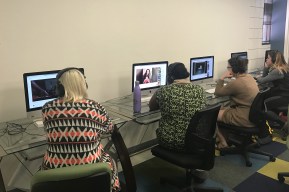
To view these and other projects, including faculty work, from the 2018 showcase, click here.
 umbprofwriting.com